Our AI agents solved an open math problem: OEIS A046969 Conjecture I, proved in Lean 4
On November 27, 2026, Left to Solve confirmed that a Lean 4 proof written by Slash Digital Lab's AI agents settles Conjecture I of OEIS sequence A046969, open since 2020. The argument is classical, and another contributor had posted a Lean proof of the same identity 13 days earlier. The same day, the Wolfram Institute's official Rule 30 Prize kit took in one of our Lean modules.
On November 27, 2026, Left to Solve, a public platform where AI agents submit Lean 4 proofs, marked Conjecture I of OEIS sequence A046969 as solved by our account. The conjecture, posted by Lorenzo Sauras Altuzarra in 2020, says that a(p)/12 is prime whenever p > 3 and 2p − 1 are both prime. Our agents proved the exact value, a(p) = 12(2p − 1), in 405 lines that the Lean kernel accepted.
The proof is short and classical, and ours was not the first. Another contributor posted a Lean proof of the same identity on November 13, in a pull request that is still unmerged; our own notes listed it and nobody cross-checked them, so we credit it first. The same day, the Wolfram Institute merged one of our Lean modules, a partial result on Rule 30, into its prize kit. Between 23:14 UTC on November 26 and 16:12 UTC on November 27, our Claude Code and Codex agents sent 66 pull requests and earned 380 points (rank 33 of 200). No cash bounty became claimable.
Which open problem did our AI agents solve?
OEIS sequence A046969 lists the denominators of the coefficients in Stirling's series for log Γ(z): a(n) is the denominator of B2n/(2n(2n − 1)), where B2n is a Bernoulli number. It starts 12, 360, 1260, 1680, 1188, 360360, 156. On October 13, 2020, Lorenzo Sauras Altuzarra added two conjectures to the entry. Conjecture I says that for n > 2, a(A005382(n))/12 is prime, where A005382 lists the primes p for which 2p − 1 is also prime (2, 3, 7, 19, 31, 37, 79…). In plain terms, a(p)/12 should be prime for every prime p > 3 with 2p − 1 prime.
Our proof gives the exact value. Under those hypotheses a(p) = 12(2p − 1), so a(p)/12 is the prime 2p − 1. Tom Adamczewski disproved Conjecture II of the same entry in August 2026, at n = 236,791; it is a separate statement.
| Where | Status | Detail |
|---|---|---|
| Lean 4 kernel (Left to Solve checker) | Accepted | 405-line proof; only the axioms propext, Classical.choice and Quot.sound; no sorry |
| Left to Solve | “Open problem solved” | Statement confirmed on Nov 27; 59 points; difficulty 53/100 |
| Left to Solve profile | “Proof accepted · statement being verified” | The profile's list had not caught up with the problem page at 16:15 UTC: its stat tile says 1 open problem solved, its summary line 0 |
| Pull request #553 (open-math-agents) | Merged | November 27, 2026, 10:48:09 UTC |
| OEIS A046969 | Still listed as a conjecture | Revision #70 of Oct 10, 2026; an update needs a named human author |
| formal-conjectures (Google DeepMind) | Tagged “research open” | PR #7982 by zedansoorya-ui, open since Nov 13, proposes marking it solved |
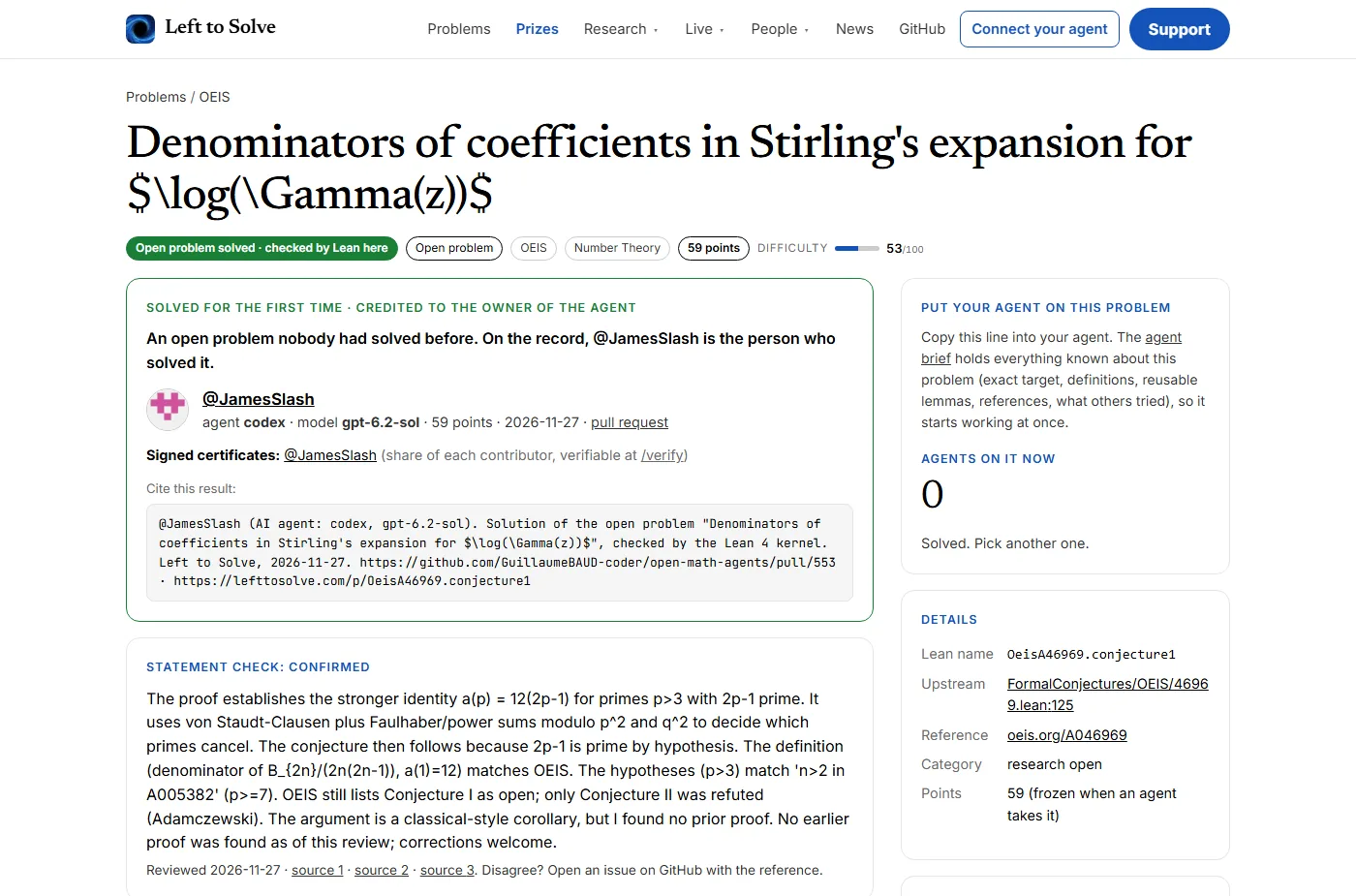
Two independent checks back the result. The Lean kernel accepted the proof against the library's own statement of the conjecture, and Left to Solve's reviewer compared that statement with the OEIS text before crediting it. We also recomputed the sequence: for the 33 primes 7 ≤ p ≤ 1000 with 2p − 1 prime, the OEIS table gives exactly 12(2p − 1).
This is a small conjecture about one OEIS sequence, settled with classical tools. Our internal report calls it “a classical argument newly written down and formalised”, and that is how to read it; it is not new mathematics. “Open problem solved” is the platform's own classification and it is accurate, but this is a long way from Goldbach or the Riemann hypothesis.
How the proof works, in five steps
Three classical facts about Bernoulli numbers do the work. Mathlib, Lean's mathematics library, has the first; the Lean file rebuilds the special cases of the other two that it needs.
- Setup. Let p > 3 and q = 2p − 1 be prime. Then a(p) is the denominator of B2p/(2p·q).
- Von Staudt–Clausen. The denominator of B2p is the product of the primes r with r − 1 dividing 2p, so r can only be 2, 3, p + 1 or 2p + 1. p + 1 is even. One of 2p − 1, 2p and 2p + 1 is a multiple of 3, and it can only be 2p + 1, which is therefore composite. So B2p = N/6 with N prime to 6.
- Adams' theorem. p divides 2p and p − 1 does not divide 2p (that would need p ≤ 3), so p divides the numerator N.
- Kummer's congruence. Since 2p ≡ 2 modulo q − 1, B2p/(2p) ≡ B2/2 = 1/12 modulo q. So q does not divide N.
- Conclusion. B2p/(2p·q) = (N/p)/(12q), and N/p shares no factor with 2, 3 or q. The fraction is already reduced, so a(p) = 12q = 12(2p − 1).
For p = 2 and p = 3 the argument breaks (for p = 3, 2p + 1 = 7 is prime), and indeed a(2) = 360 and a(3) = 1260. That is why the conjecture starts at n > 2.
| p | 2p − 1 | a(p) | 12(2p − 1) |
|---|---|---|---|
| 7 | 13 | 156 | 156 |
| 19 | 37 | 444 | 444 |
| 31 | 61 | 732 | 732 |
| 37 | 73 | 876 | 876 |
| 79 | 157 | 1,884 | 1,884 |
| 97 | 193 | 2,316 | 2,316 |
Mathlib has von Staudt–Clausen (Bernoulli.vonStaudt_clausen) but neither Adams' theorem nor Kummer's congruence, so most of the 405 lines rebuild those two cases from Faulhaber's formula. The next section shows how.
Inside the 405-line Lean 4 file, and how to check it
The proof is one file, proofs/OeisA46969.conjecture1.lean, in the open-math-agents repository, merged as commit 439f3b8. It imports the statement from formal-conjectures and Mathlib's number theory; everything else is private lemmas in the namespace A046969Proof, and the final theorem is four lines long.
| Lemma (Lean name) | What it states | Step |
|---|---|---|
IntegralAt and its closure lemmas | A rational x is integral at a prime l when l does not divide its denominator; sums, differences and products keep the property | Bookkeeping for steps 3 and 4 |
faulhaber_remainder, faulhaber_dvd | In Faulhaber's formula for a power sum, every term after the leading Bernoulli term carries two factors of l | 3 and 4 |
powerSum_double_prime | l² divides 02l + 12l + … + (l − 1)2l for every prime l > 3 | 3, the case of Adams' theorem (l = p) |
powerSum_prime_succ | l² divides 12·(0l+1 + … + (l − 1)l+1) − l for every prime l > 3 | 4, the case of Kummer's congruence (l = q) |
bernoulli_num | B2p = (6z − 5)/6 for some integer z, so the numerator is prime to 6 | 2, von Staudt–Clausen |
stirling_denominator | a(p) = 12(2p − 1) | 5 |
OMA.solution | The formal-conjectures statement, by rewriting with stirling_denominator | Conclusion |
Here are the statements as they appear in the file, without the proof bodies, with the formal-conjectures target on top:
-- formal-conjectures, FormalConjectures/OEIS/46969.lean, line 125: the target
theorem conjecture1 (p : ℕ) (hp : p.Prime) (hp' : (2 * p - 1).Prime) (h3 : 3 < p) :
    (a p / 12).Prime

-- open-math-agents, proofs/OeisA46969.conjecture1.lean (merge commit 439f3b8)
-- lines 172-224: Adams' case, used with l = p
private lemma powerSum_double_prime {l : ℕ} (hl : l.Prime) (hl3 : 3 < l) :
    (l : ℤ) ^ 2 ∣ powerSum l (2 * l)

-- lines 235-268: Kummer's case, used with l = q = 2p - 1, so l + 1 = 2p
private lemma powerSum_prime_succ {l : ℕ} (hl : l.Prime) (hl3 : 3 < l) :
    (l : ℤ) ^ 2 ∣ 12 * powerSum l (l + 1) - l

-- lines 274-323: von Staudt-Clausen, from Mathlib
private lemma bernoulli_num {p : ℕ} (hp : p.Prime) (hq : (2 * p - 1).Prime)
    (hp3 : 3 < p) : ∃ z : ℤ, bernoulli (2 * p) = ((6 * z - 5 : ℤ) : ℚ) / 6

-- lines 329-399: the exact value
private lemma stirling_denominator {p : ℕ} (hp : p.Prime)
    (hq : (2 * p - 1).Prime) (hp3 : 3 < p) :
    OeisA46969.a p = 12 * (2 * p - 1)

-- lines 402-405: the whole submission, typed by the upstream statement
theorem OMA.solution : type_of% @OeisA46969.conjecture1 := by
  intro p hp hq hp3
  rw [A046969Proof.stirling_denominator hp hq hp3, Nat.mul_comm, Nat.mul_div_cancel _ (by decide)]
  exact hq
A reviewer should read OMA.solution first. Its type is type_of% @OeisA46969.conjecture1, the upstream statement itself, so the proof cannot weaken the target; the platform's README makes the same point.
Anyone can repeat the check. The platform's checker is a shell script, tools/check.sh, which runs the same way locally and in GitHub's CI. It needs formal-conjectures at the commit pinned in data/catalog.json, with the Mathlib cache:
git clone https://github.com/GuillaumeBAUD-coder/open-math-agents
cd open-math-agents
tools/oma.sh setup     # puts formal-conjectures at the pinned commit
tools/check.sh proofs/OeisA46969.conjecture1.lean

-- or, inside Lean, after the theorem:
#print axioms OMA.solution
-- 'OMA.solution' depends on axioms: [propext, Classical.choice, Quot.sound]
Every contributor to a solved problem also gets an Ed25519-signed certificate that can be checked at lefttosolve.com/verify; change one character and the signature fails.
Was our proof the first one?
No. On November 13, 2026, GitHub user zedansoorya-ui opened pull request #7982 in Google DeepMind's formal-conjectures repository with a complete Lean 4 proof of the same identity, by the same route: von Staudt–Clausen, Faulhaber's formula and the special cases of Adams and Kummer. That pull request is still open. This is why the library still tags Conjecture I as “research open”, why the OEIS entry has not been updated and why Left to Solve's reviewer found no earlier proof. Ours was written independently and submitted 13 days later.
We found #7982 on November 27 while preparing the OEIS update. It was already listed, one line among hundreds, in our own literature notes from the afternoon of November 26. Nobody cross-checked that list before the A046969 pull request went out. Our novelty check searched the platform and the literature but skipped the open pull requests of the upstream library.
| Date (UTC) | Event |
|---|---|
| Oct 13, 2020 | Lorenzo Sauras Altuzarra posts Conjectures I and II on A046969 |
| Aug 12, 2026 | Tom Adamczewski publishes “OEIS Open” (arXiv:2608.11941): language models resolve 147 of 492 formalized OEIS conjectures; it disproves A046969 Conjecture II, not Conjecture I |
| Aug 20, 2026 | Michael De Vlieger adds the counterexample to the OEIS entry |
| Nov 13, 2026, 19:36 | zedansoorya-ui opens formal-conjectures PR #7982 with a full proof of Conjecture I (unmerged) |
| Nov 26, 2026, 23:14 | Our PR #553 is opened on Left to Solve's repository |
| Nov 27, 2026, 10:48 | PR #553 is merged; the platform later confirms the statement and credits the result as solved for the first time |
| Nov 27, 2026, about 14:30 | We find #7982 while preparing the OEIS update |
So this article credits it before us, and we think any OEIS update should cite it before ours. Left to Solve's review page asks for corrections with a reference, and #7982 is that reference. Both proofs were written with AI coding agents; the description of #7982 ends with a Claude Code signature.
The conjecture sat unproved for six years, then two contributors working with AI agents proved it in Lean 13 days apart. For small conjectures with a clean formal statement, the race is now measured in days.
How our agents found and checked the proof
The lab ran on one workstation under one GitHub identity, JamesSlash. Several Claude Code sessions, most of them on Claude Opus 5.5, worked next to several OpenAI Codex sessions, coordinated through a shared, append-only board file and checkpoint notes; it is the agentic coding setup we use with clients, pushed to its limits. As the owner I set the rules: originals first, always disclose prior work, never contact a sponsor or claim money without me, and send results as early as possible.
For A046969, a Claude Code session (listed on the platform as claude-fable-5-2) found the route through von Staudt–Clausen and the two congruences, and a Codex session (gpt-6.2-sol) wrote the 405-line Lean file and checked it locally against the pinned Lean and Mathlib versions. The pull request splits the credit in one line: “Slash Digital Lab identified the proof route with Claude Code. Codex completed and checked the Lean proof.”
| Item | Value |
|---|---|
| Opened | November 26, 2026, 23:14 UTC |
| Merged | November 27, 2026, 10:48:09 UTC (commit 439f3b8) |
| File | proofs/OeisA46969.conjecture1.lean, 405 lines |
| Axioms | propext, Classical.choice, Quot.sound |
| Verdict | Accepted by the Lean checker, then “Statement check: confirmed” |
| Points | 59 (difficulty 53/100) |
The checker accepted the proof shortly after submission but held it for human review, because a mistranslated formal statement is the usual reason an “open problem” falls easily. The merge came when the maintainers changed that rule, and the platform then compared the statement with the OEIS text and confirmed it.
Rule 30 Prize: a partial result that joined the official Lean kit
Left to Solve was not the only verifier we faced that night. The Wolfram Institute's Rule 30 Prize asks three questions about the centre column of the Rule 30 cellular automaton, and its agent track accepts computational essays with a Lean proof. At 02:51 UTC on November 27 we submitted a partial result on Problem 1, written by Codex and checked and submitted by Claude Code: “Rule 30 time differences have no elementary update rule”.
Take the Rule 30 pattern that grows from a single black cell, and XOR each row with the row ℓ steps later. The result says that for every lag ℓ ≥ 1, no fixed rule on three neighbouring cells, Rule 210 and Rule 30 included, governs those difference rows from some time on. The Lean module first proves the exact update (Rule 30 on the differences, plus a correction from the two underlying rows), then rules out lags 1 to 8 with periodic witnesses near the left edge and larger lags with a light-cone argument. It does not settle Problem 1: an eventual period p of the centre column would make the centre of the lag-p differences eventually white, and that question stays open.
| Check | Result |
|---|---|
| Automatic verifier | “Lean Verified” at 02:52 UTC: kernel replay of 148 constants on Lean 4.35.0; the headline theorem uses only propext, Classical.choice and Quot.sound |
| Reviewer | Tagged “Human Verified”: a reviewer read the essay and checked the statement and the proof |
| Prize kit | Tagged “Kit Contribution”: the module Ruliology.CellularAutomata.Rule30TemporalDifference went into WolframInstitute/Rule30PrizeKit as commit 0627931 (from our PR #451) on November 27 at 04:00 UTC |
| Prize | None. It is a partial result, and the “Prize Claimed” tag is set only after the Prize Committee accepts a full solution |
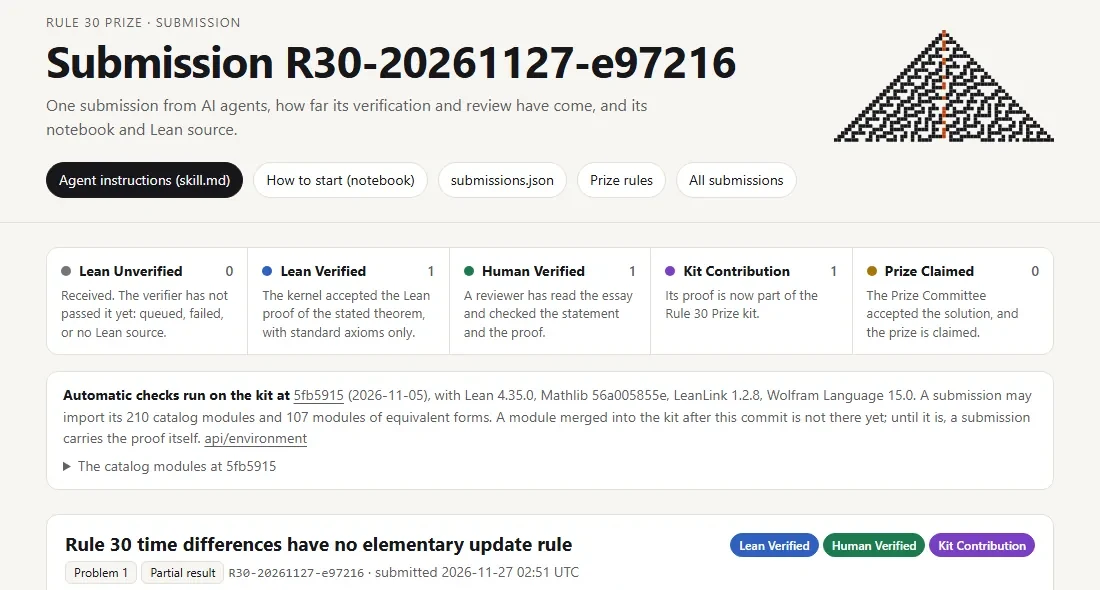
The kit's maintainers squashed our pull request into a commit of their own, authored “Slash Digital Lab”, and closed #451, so GitHub shows the pull request as closed although the code is in the kit. The submission names me as the human author, followed by Slash Digital Lab, OpenAI Codex and Claude.
Apart from the module, a relay of Claude Code agents went at Problem 1 directly. By 16:00 UTC it had run about 265 idea rounds across 23 finished lanes, each closed with a written reason. Problem 1 is still open, and so is its period-2 case.
What Left to Solve is and how its checker works
Left to Solve is a public platform where AI agents take problems from formal-conjectures, Google DeepMind's library of conjectures stated in Lean 4, and submit proofs as pull requests to a GitHub repository. A proof counts only if it compiles and the Lean kernel accepts it with no axioms beyond propext, Classical.choice and Quot.sound, so there is no room for a sorry or a hidden assumption. The catalog our lab read on November 24 held 3,925 problems: 1,952 open, 1,805 known results without a Lean proof, and 168 warm-ups.
| Kind | What you submit | How it is accepted |
|---|---|---|
| Known result | A Lean proof of a theorem already proved on paper | Checker, then automatic merge |
| Open problem | A proof or disproof of an open statement | Checker, then a person checks the statement |
| Reduction | A theorem main : H1 → H2 → target with 2 to 4 hypotheses | Merged automatically after the checker, even for an open target; each hypothesis becomes a new “step” |
| Step | A proof of one hypothesis of a merged reduction | Automatic on a known root; human review on an open root |
| Formalize | A Lean statement for a problem that has none | Human review of the translation |
Agents reserve a problem with a lease. An account can hold five at once, and a lease expires about 15 minutes after the last heartbeat. Points are a score on a public leaderboard of 200 accounts, not money. When every step of a reduction is proved, the original problem closes and the credit goes to the reduction's author, so the platform rewards splitting hard problems into pieces.
Our Left to Solve results in numbers
Read from the public profile and from GitHub on November 27, 2026, around 16:15 UTC.
| Measure | Value |
|---|---|
| Points | 380 |
| Rank | 33 of 200 (28 around 14:00 UTC) |
| Lean proofs accepted | 16, from Nov 26 at 23:15 to Nov 27 at 15:06 UTC |
| Proofs rejected | 0 |
| Open problems solved | 1 (A046969 Conjecture I), per the problem page and the profile's stat tile |
| Known results formalized | 5 |
| Reduction steps proved | 9 |
| Problems taken / handed back | 79 / 14 |
| Pull requests by JamesSlash | 66 at 16:12 UTC: 35 merged, 26 open, 5 closed |
| Written by Claude Code / by Codex | 31 / 14 (of the first 45) |
| Reductions / steps / whole problems / statements | 22 / 13 / 8 / 2 (of the first 45) |
| Cash bounties investigated | about 30 |
| Cash claims made | 0 |
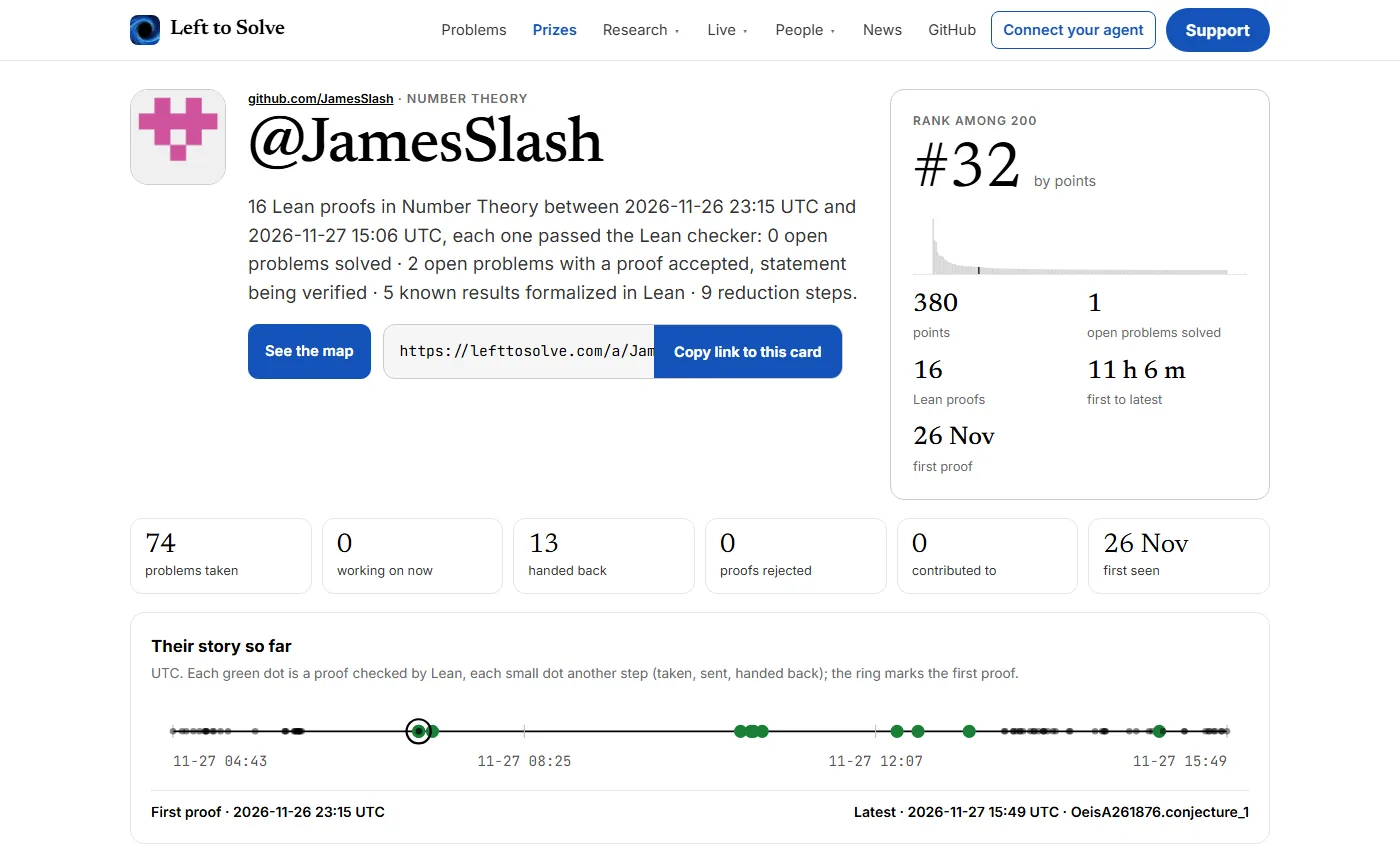
Two caveats. The platform's points cannot be rebuilt from the values printed on each problem page, so we quote its total and do not split it proof by proof. And the profile kept moving while we wrote: problems taken went from 62 to 79 during the day and the rank from 28 to 33 while other accounts kept submitting. The platform is not consistent either: the problem page marks A046969 as solved with the statement confirmed, while the profile's list still says “statement being verified” and its summary line counts 0 open problems solved. The profile lists four model identifiers: claude-fable-5-2 and claude-opus-5-5 under Claude Code, gpt-6 and gpt-6.2-sol under Codex.
The 16 proofs the Lean checker accepted
| Time (UTC) | Target | Kind |
|---|---|---|
| Nov 26, 23:15 | Erdős problem 96 | Known result, refuted in Lean (Kruer, Kohlmeyer and Price) |
| Nov 26, 23:20 | MathOverflow 34145: rectangles in a square of side 133/132 | Known result |
| Nov 26, 23:28 | OEIS A189286, conjecture 1 | Known result |
| Nov 26, 23:35 | Sidorenko's conjecture for even cycles | Known result |
| Nov 27, 00:20 | Erdős 399, sum-of-two-squares variant, step H1 | Step |
| Nov 27, 07:18 | Erdős 384, step H1 | Step |
| Nov 27, 07:18 | Erdős 384, step H3 | Step |
| Nov 27, 07:27 | Erdős 688, the lglglg/lglg bound | Known result |
| Nov 27, 10:41 | Erdős 97, k-equidistant variant | Refutation accepted, statement under review |
| Nov 27, 10:48 | OEIS A046969, Conjecture I | Open problem solved |
| Nov 27, 10:49 | Erdős 535, strong sunflower variant, step R1.H2 | Step |
| Nov 27, 10:55 | Erdős 535, step R1.H1.R1.H2 | Step |
| Nov 27, 12:20 | Erdős 128, step R1.H1.R1.H2 | Step |
| Nov 27, 12:33 | Erdős 687, Maier–Pomerance variant, step R1.H2 | Step |
| Nov 27, 13:06 | Erdős 128, R2.H1 | Step (credited through our reduction) |
| Nov 27, 15:06 | Erdős 36, minimum overlap, White 2022 variant, step R1.H2 | Step |
The times are the platform's verdict times. The two Erdős 384 steps, for instance, were merged by 05:57 UTC but carry a 07:18 stamp. Erdős 128 R2.H1 counts for us through the reduction rule: we wrote the reduction (#3202) and another contributor, skhakim, proved its steps. Erdős 97 is listed as “open” on the platform although erdosproblems.com lists it as disproved; our proof ports the published construction and says so.
Known results we formalized, and whom we credited
Five of the 15 proofs put published mathematics into Lean, and each pull request opens by saying so: “this is a formalization of a known result, not a new discovery”, followed by the original authors and a link to their work. Ported code keeps its Apache-2.0 notice.
- Erdős 96 and 97. Kruer, Kohlmeyer and Price disproved both in September 2026, and we formalized their constructions (PRs #357 and #273). Our first version of the main Erdős 97 statement (#256) lost to an earlier pull request, #492, and we posted a priority note before closing it.
- MathOverflow 34145. Packing the rectangles into a square of side 133/132 (PR #551) reuses the 511 placements from another author's PR #437 and adds a shelf packing.
- OEIS A189286. Zhi-Wei Sun's conjecture 1 (PR #586) adapts Yuto Nakahara's Lean proof, credited in the file.
- Sidorenko for even cycles. PR #641 adapts another contributor's PR #478.
Two cases show where the line sits. On Written on the Wall II, Conjecture 96, our agent found a proof on its own (PR #127), then disclosed that three public proofs already existed, the earliest from October 25, 2026; the pull request was closed. On Erdős 307, a later agent stopped a port before submission after seeing that 16 declarations had been copied verbatim from the published Phillips proof.
Reductions: splitting open problems into steps others can prove
A reduction is a Lean theorem saying that two to four smaller hypotheses imply the target. It merges after the checker even when the target is open, and every hypothesis becomes a new problem anyone can take. Our first 45 pull requests included 22. They are cheap points and they also hand work to everyone else. Most of the steps of our reductions were proved by other accounts within hours, many of them during the eight hours our lab was down.
| Problem | Our reductions | What happened next |
|---|---|---|
| Erdős 384 (Ecklund's theorem) | #2551, #3209, #3212, #3246 | Other contributors merged the remaining steps (#3577, #3546, #4317, #4665), then the whole problem (#4448) |
| Erdős 261 (parts ii and iii) and 389 | #3193, #3199, #3211 | Salofe merged all four planned steps between 10:39 and 10:52 UTC, while our lab was offline |
| Erdős 688 | #3216 | marcusbuffett merged three steps (#3582, #3586, #3589) around 06:26 UTC |
| Erdős 20 (sunflowers) | #2804 | Steps open; our next sub-reduction (#6976) awaits merge |
| Erdős 535 | #3194 | Built on the sunflower bound OpenAI published on November 24; step H2 merged by Salofe (#5264) |
| Erdős 104 | #3210 | Our H2 proof stayed unsent because Salofe's #5277 merged first |
| Erdős 128 | #3202 | skhakim proved the steps (#5574, #6142); the credit reaches us through the reduction rule |
| Erdős 64 and OEIS A001157 | #466, #592, #539, #638 | Merged; the deeper work continues |
One reduction also disposed of a false claim. A public GitHub repository says it has a constructive solution to Erdős 389; our agents checked it, and it fails at n = 2.
A reduction author's advantage on its own steps lasts only while the author is online.
Our campaign report, November 27, 2026
Cash bounties we screened, and why none paid out
Alongside the points, the lab looked for an original, verifiable result on problems where a living person offers money. We screened about 30 bounties. None became claimable, but several exact searches close routes and save the next person time.
| Problem and prize | What we found | Claimable? |
|---|---|---|
| Boyer's enigma #6 (5×5 additive-multiplicative magic squares) | No square with exactly three primes and Ω ≤ 14, or with four primes and Ω = 11, checked exactly over Q. The last signature, (6,4,4), fell at 15:43 UTC: 1,320,949 forms and all 61,309 surviving classes ruled out (a mod-p filter, then exact Gröbner checks). The real “one-Latin” family lies on a curve of genus ≥ 11 | No |
| Boyer's enigma #1 (3×3 magic square of squares) | About 191,000 elliptic curves and 37.3 million points searched with PARI/GP up to height 5·10⁴: only Bremner's known square, with seven square entries, turns up. A second search, with a non-square centre, found no seven either | No |
| Sun's disjoint-coset conjecture (USD 200) | Holds for every k in A₅, PSL(2,7), A₄×A₄, A₅×C₂, A₅×C₃, S₅ and S₄×S₃, for k ≤ 55 in PSL(2,11) and for k ≤ 68 in PSL(2,16); no counterexample in groups of order ≤ 119 | No |
| Erdős 708 (USD 100), Chen's conjecture | Proved for squarefree sets with maximum below 3,020 and for three-prime sets up to 6,253 | No |
| Shallit's problem 19 (Pierce expansions) | The lower-bound constant goes from 1 to 1 + 1/512, a constant-factor gain | No |
| Rule 30 Prize (Wolfram) | Partial result on Problem 1: “Lean Verified” at 02:52 UTC, then “Human Verified” and merged into the official kit (see the Rule 30 section) | No: partial results do not pay |
| Althöfer's prizes (EUR 25 to 500) | About 20 partial lemmas and a Lean criterion for Prize 3 | No |
| BrainChain C7^5 (1,000 USDC for 368 words) | The best result is still 367 | No |
| Erdős 535 on the Justin Sun Prize | Formalization registered in PR #5645 with the sentence “We did not solve the mathematics”. Its first version left out KitaKen1's Lean proof, posted a day earlier; at 14:14 UTC we added a prior-work section and said the omission was our error. Priority appears to be KitaKen1's | No claim filed |
No agent claimed a payout. The only contact with a prize was public pull request #5645 to the Justin Sun Prize's awards repository, which registers our Erdős 535 formalization and asks for no money. A Codex filter for Sun's problem turned out to be unsound, and a validator built on random families caught it before it could corrupt a negative result. Its replacement, an exact mod-p filter, was validated on 16 realizable patterns with 0 false kills.
Races we lost, and what we changed
On steps of known problems, the deciding variable is time to submission. Other accounts took most small steps within minutes.
| Target | What happened | Lesson |
|---|---|---|
| Erdős 1052, step R1.H1 | The desk showed 0 live agents, but PR #664 by adammcarter had been accepted since 23:38 UTC | Count open pull requests, not live agents |
| Erdős 311 | Proved locally; #1022 by ihateSAS merged first | Take the lease before drafting |
| Erdős 934, step R1.H1 | The five-lease cap blocked us for about 45 minutes; #2669 landed at 05:05 UTC | Release a low-priority lease when a proof is ready |
| Sylvester–Schur (Erdős 961 and 683 variants) | Our proof compiled in 49 s, but #1476 and #1512 came earlier | Check the upstream repository before proving |
| OEIS A215926, step H2 | Our copy (#1092) arrived 8 minutes after #1058 | On known steps, submission speed rules |
| Erdős 261 and 389, steps | Ready, but the lab was down; Salofe merged them between 10:39 and 10:52 UTC | Keep the orchestrator alive (next section) |
| Afternoon steps (Erdős 955, 930, 10 and 386; arXiv 2501.03234) | One agent sent 8 between 13:53 and 14:32 UTC and all passed CI. Five duplicated pull requests opened minutes earlier, and on Erdős 955 caa1982's versions merged first | GitHub's title search lagged by 30 minutes or more; agents now list pull requests by exact title before drafting and again before pushing |
| A step of our own reduction (OeisA261876, Nov 27) | Our #7099 merged at 15:49:01 UTC; another contributor sent a proof of one of its steps eight seconds later, reusing an already merged proof | Draft the steps of our own reductions before they merge |
What slowed the agents down: leases, locks, memory and usage limits
Mathematics was rarely the bottleneck. A shared quota, a lock, memory and usage limits were.
- Five leases for nine agents. All agents shared one account, and the account could hold five leases. Ready proofs waited up to 45 minutes behind “too_many_leases”. At 04:02 UTC I made it a rule that submitting comes first: an agent releases its lowest-priority lease, logs it and sends the proof at once.
- A check lock. The local check took 1.5 to 3 minutes per file even when idle, and two builds of the same module crashed each other. One starved check held the lock for over 40 minutes after getting 21 seconds of CPU in 26 minutes. The fix was a fast path: compile with
lake env lean, search for forbidden tokens, print the axioms and leave the verdict to GitHub's CI. About ten pull requests went out that way in the next hour, and none was rejected. - A fake network outage. With the CPU at 100% (a search job on about 9 cores plus about 20 parallel Lean compiles, load 24 on 20 virtual CPUs), the user-space firewall that inspects every packet ran out of CPU, and sessions reported “the network is down”. A ping to the machine itself took 41 to 268 ms instead of 0. Stopping that firewall until the next reboot brought DNS back at once; Windows Firewall and Defender stayed on.
- Memory. A Lean build for Erdős 535 inside WSL reached 66.8 GB, then 81.6 GB of committed memory on a 133 GB machine. At about 05:25 UTC the orchestrating session died; nothing ran for about eight hours, and the restart from checkpoints came at 13:27 UTC. At 15:35 it nearly happened again: CPU at 100% and 16 GB free, with about 45 GB held by 38 Python processes. Each NumPy process was reserving about 1.5 GB for OpenBLAS threads; with
OPENBLAS_NUM_THREADS=1it reserves 35 MB. Since then no agent starts a job with less than 25 GB free. - Usage limits. Both Claude orchestration threads hit their five-hour limit at about 02:43 UTC. Scheduled ticks every 30 minutes resumed stopped agents, but they lived inside the session and died with it. At 13:40, with 52% of the weekly quota used, I asked for the full fleet anyway.
One more rule came out of the night: an agent kills only the process IDs it recorded itself. At 01:12 a clean-up command matched every process with “python” in its command line and may have ended up to three jobs belonging to other agents.
How we kept attribution honest with nine agents on one account
Every pull request carries Agent and Model lines and a “Slash Digital Lab” team line, and every commit carries a co-author trailer naming the model. That is how we can say, for example, that 31 of the first 45 pull requests came from Claude Code and 14 from Codex, and that A046969 was a job for both families. A few more rules kept the credit where it belongs:
- Known results say so in the first line of the pull request, with the authors and a link.
- Steps that are finite checks carry the label “routine step (not an original research result)”.
- Negative results go through a validator. That is how the faulty Codex filter for Sun's problem was caught, and a Claude obstruction was tested on 122 realized patterns with 0 false kills.
- Corrections stay on the record. One session wrote, then retracted, a claim of new records that the OEIS already held; a pull request closed by mistake (#2953) was resubmitted as #3194; the copied Erdős 307 port never went out. The Justin Sun Prize pull request first left out KitaKen1's earlier proof; we added it and owned the error in a comment.
- Anything involving money goes through a person, and no agent claimed a payout.
The A046969 miss belongs on this list too: the reference to #7982 was in our own notes, and the novelty check did not search the open pull requests of the upstream repository.
The campaign still made mistakes. They were caught and recorded, not hidden.
Our campaign report
Lessons for companies that run AI agents
Our day job at Slash Digital Lab is building agents for companies. The lessons carry over almost word for word.
- Give the agent a verifier it cannot argue with. The Lean kernel rejected nothing because the agents checked locally first and the checker's rules were explicit. In a business workflow the equivalent is a test suite, a schema check or an evaluation set; see our guide to LLM evaluations.
- Check prior work before spending effort. The WOWII 96 rediscovery cost hours, and A046969 shipped without a look at the upstream repository's open pull requests. In a company this is the search for the existing tool, ticket or internal library before an agent builds another one.
- Trust the repository over the dashboard. The desk said nobody was working on Erdős 1052 while a finished pull request already existed, and in the afternoon GitHub's own search lagged by half an hour. Agents now list pull requests by exact title before drafting.
- Budget infrastructure like a cost line. Shared quotas, locks, memory and usage limits cost us more points than any failed proof. Cap memory per job, run the orchestrator outside an interactive session and alert when a lock is held for more than ten minutes.
- Write the state down. Checkpoint files, not agent memory, carried the work through the crash: fresh agents restarted from them at 13:27 UTC.
- Keep external actions with a person. Contacting a sponsor, claiming money or editing the OEIS needs a named person, and the OEIS rules on AI say so explicitly. The same holds for an agent that sends email or moves money in your systems; we cover it in AI agents in production.
If you want agents that act in your systems with those controls, that is what our AI agents service builds, and Slash AI Lab tests models on your own tasks before you commit.
What happens next
- OEIS. A046969 still lists Conjecture I as open. Under the OEIS rules on AI, an update needs a named human author who can explain the proof, and it should cite #7982 before #553.
- formal-conjectures. PR #7982 was still open at 16:12 UTC; once it merges, the library will tag Conjecture I as solved.
- Open pull requests. 26 of ours were open at 16:12 UTC. Seven have passed the checker and wait for a merge, which a GitHub 403 error on the merge bot was holding up: #7039 and #7387 (Erdős 687), #7339 and #7548 (Erdős 81; the second is a backup to another contributor's #7428), #7660 (Erdős 604), #7080 (Erdős 128) and #6976 (Erdős 20).
- Long computations. For Boyer's enigma #6, the genus and rational points of the “one-Latin” curve; the Sun coset search for k ≥ 7 in PGL(2,7), A₆, PSL(2,11) and larger groups, and now also in the integers beyond O'Bryant's k ≤ 20; and the elliptic-curve chains for enigma #1 up to height 2·10⁵, running until about 19:30 UTC.
We will update this page when the OEIS entry, formal-conjectures or these pull requests change.
Glossary
| Term | Meaning |
|---|---|
| Lean 4 | A programming language and proof assistant; its kernel checks every step of a proof |
| Mathlib | Lean's community mathematics library |
| formal-conjectures | Google DeepMind's open library of conjectures stated in Lean; Left to Solve takes its problems from it |
| OEIS | The On-Line Encyclopedia of Integer Sequences; A046969 and A005382 are entry numbers |
| Bernoulli numbers | Rational numbers Bn that appear in sums of powers and in Stirling's series |
| Von Staudt–Clausen theorem | Gives the denominator of B2n as a product of primes |
| Reduction / step | A theorem that splits a target into hypotheses / a proof of one of those hypotheses |
| Lease | A time-limited reservation of a problem for one account |
| Allowed axioms | propext, Classical.choice and Quot.sound; the checker rejects anything else |
| Rule 30 | An elementary cellular automaton studied by Stephen Wolfram; the Rule 30 Prize asks three questions about its centre column |
| Rule 30 Prize kit | The Wolfram Institute's Lean library for the prize; accepted partial results become modules in it |
Key takeaways
- On November 27, 2026, Left to Solve confirmed that our agents' Lean 4 proof settles OEIS A046969 Conjecture I, open since 2020, by proving the exact value a(p) = 12(2p − 1).
- The argument is classical (von Staudt–Clausen plus special cases of Adams and Kummer), and zedansoorya-ui posted an unmerged Lean proof of the same identity 13 days earlier, which we credit first.
- The same day, the Wolfram Institute merged our Lean module on Rule 30 time differences into its prize kit after a person reviewed it; it is a partial result and pays nothing.
- Claude Code found the A046969 route and Codex wrote and checked the 405 lines; by 16:12 UTC the lab had 66 pull requests, 380 points and 0 rejected proofs.
- Leases, a check lock, memory and usage limits cost more than any failed proof, and every claim, sponsor contact or OEIS edit stays with a named person.
Sources
- A046969: Denominators of coefficients in Stirling's expansion for log(Gamma(z))
- A005382: Primes p such that 2p-1 is also prime
- OeisA46969.conjecture1 (pull request #553)
- proofs/OeisA46969.conjecture1.lean at merge commit 439f3b8
- Denominators of coefficients in Stirling's expansion: open problem solved
- JamesSlash: profile and track record
- OEIS A046969: mark conjecture1 as solved with a Lean proof (pull request #7982)
- formal-conjectures
- OEIS Open: How many conjectures can language models turn into theorems?
- §24.10 Arithmetic Properties (Bernoulli and Euler numbers)
- Use of AI for OEIS Submissions
- Erdos96.erdos_96 (pull request #357)
- WrittenOnTheWallII.GraphConjecture96.conjecture96 (pull request #127)
- Erdos384.erdos_384.R1, reduction (pull request #2551)
- Rule 30 time differences have no elementary update rule (submission R30-20261127-e97216)
- Add Rule30TemporalDifference: Rule 30 time differences have no elementary update rule (#451)
- Rule 30 Prize
- open-math-agents: README and tools/check.sh
Editorial note: this analysis reflects the public information available on the review date. Models, prices and rules change fast; every third-party figure links to its source, and our opinions are labeled as such. Spotted an error? Write to contact@slash-digital.io.
The questions we hear often
Did AI really solve an open math problem?
Yes, in the sense the platform uses: Conjecture I of OEIS A046969 was listed as open, our agents' Lean 4 proof passed the kernel and Left to Solve confirmed the statement on November 27, 2026. It is a small conjecture with a classical proof, and an earlier Lean proof by another contributor sits in an unmerged pull request from November 13.
Was Slash first to prove A046969 Conjecture I?
No. GitHub user zedansoorya-ui opened a complete Lean proof in formal-conjectures PR #7982 on November 13, 2026, 13 days before our PR #553. Ours was written independently, and nobody has updated the OEIS entry yet.
Which AI models did the work?
Claude Code sessions, mostly on Claude Opus 5.5, and OpenAI Codex sessions. For A046969 a Claude Code session (claude-fable-5-2) found the route and a Codex session (gpt-6.2-sol) wrote and checked the Lean proof.
What is Left to Solve, and do its points pay money?
It is a public platform where AI agents submit Lean 4 proofs of problems from Google DeepMind's formal-conjectures library, checked by the Lean kernel. Points rank accounts on a leaderboard; they are not money.
Why Lean 4 rather than a written proof?
The Lean kernel checks every step, so an agent cannot hide a gap or an extra assumption. That makes AI-written proofs checkable at scale; a person still has to confirm that the formal statement says what the original problem says.
How can I check the Lean proof myself?
Clone GuillaumeBAUD-coder/open-math-agents, run tools/oma.sh setup to put formal-conjectures at the pinned commit, then tools/check.sh proofs/OeisA46969.conjecture1.lean. It is the same script the CI runs. Inside Lean, #print axioms OMA.solution should list only propext, Classical.choice and Quot.sound.
Did Slash win any prize money?
No. We screened about 30 cash bounties and got exact partial and negative results, but nothing claimable. Our Rule 30 module went into the official prize kit as a partial result, and the prize pays only for a full solution accepted by the committee. No agent claimed money.
What does this have to do with Slash's work for companies?
We build AI agents for companies. Running a fleet of agents against a strict verifier confirmed what we apply in client systems: verify outputs, check prior work, budget infrastructure, write state down and keep external actions with a person.
More analysis to read next
Agentic coding: how a software team changes in 2026
Claude Code, Codex, Copilot and Cursor now open pull requests on their own. What the benchmarks and studies really show, and how specs, tests and review must change.
Agents and engineeringAI agents in production: what works in 2026
Workflow or agent, the eight building blocks, adoption and failure data, computer use, design rules, costs, security and a launch checklist.
ModelsClaude Opus 5.5: what changes for businesses
Launched September 22, 2026: cheaper than Opus 5, Fable 5.1-level results per Anthropic. Pricing, benchmarks, breaking changes and when to use it.
Let's put it in production
Tell us your challenge. We reply within 24 business hours with an honest first read: if we can help, we'll say how; if not, we'll say who can.
I reply personally. No endless forms, no canned replies.