Support & care
Answers grounded in your knowledge base with citations, ticket handling and human handoff where needed.
Agents with tools, memory and human oversight for support, ops and back office. Whatever fails failure-evaluation doesn't deploy.
Slash Digital Lab builds AI agents for companies from Bogotá: agents that use real tools (not just answers), remember business context and know when to stop and call a person. We build them for support, ops, engineering and back office.
In production: Auto Fiche for Les Gentlemen du Jeu, which researches the web and generates product sheets with AI inside PrestaShop, and Mia, the AI copilot in the Réseau Mazette app. What works with agents and what doesn't: AI agents in production and prompt injection.
Every agent has tools, limits and an owner. None decides alone what it mustn't.
Answers grounded in your knowledge base with citations, ticket handling and human handoff where needed.
Monitoring, alerts and automated actions on your systems, with an auditable log of every step.
Self-writing documentation, reconciliations, follow-ups and recurring reports.
Code review, test generation and technical documentation for your team.
A process with volume and clear rules: where an agent genuinely wins. Written and measured.
Which APIs and actions the agent may use, which it can't, and how it escalates to a human.
We break it on purpose: hostile prompts, dirty data, dead tools. Bad failures go back to design.
Metrics, logs and a runbook; we review escalations weekly with your team.
| Agent design | Architecture, tools, memory and the human-escalation policy. |
|---|---|
| Integration | CRM, helpdesk, ERP or own APIs; identity and permissions by role. |
| Guardrails | Moderation, topic limits and personal-data protection. |
| Metrics | Resolved, escalated, handling time and satisfaction, published weekly. |
| Runbook | What to do when something fails, with owners. |
| Languages | Spanish, English and French. |
Production systems with integrations, roles and live data: the foundation an agent runs on.
 Read more
Les Gentlemen du Jeu · Auto Fiche
Auto Fiche PrestaShop module for Les Gentlemen du Jeu: generates board-game product sheets with AI (SEO, players, duration, age, FAQ and images) from automatic web research.
Learn more →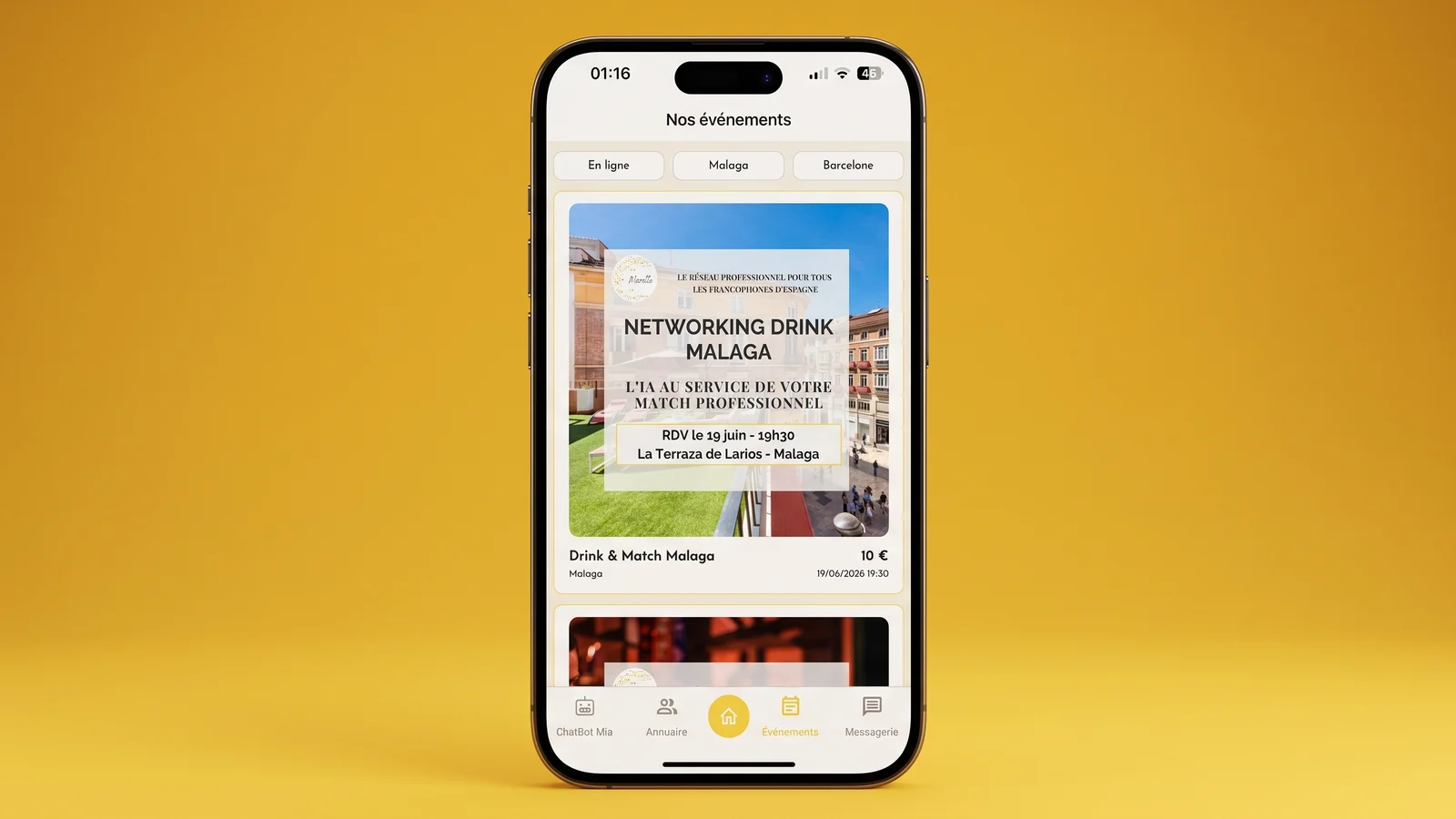 Read more
Réseau Mazette · Flutter app
Réseau Mazette connects French-speaking professionals and entrepreneurs in Spain. We shipped a full native Flutter app for iOS and Android: directory, events, messaging, memberships and AI copilot Mia, plus the branded web experience.
Learn more →Not a chatbot with a better prompt: it's software that decides steps, uses tools and delivers measurable outcomes. When unsure, it calls a person.
Yes, plus custom integrations when the client's system lacks standard APIs.
Citation-grounded responses, role-based action limits and failure evaluation before and after deploy.
A process with volume, rules and a system to integrate with; discovery then scopes it.
The client's team, with defined escalations and weekly metrics; we never run blind.
It depends on task volume, how many systems it must use, the level of human oversight and the model. We scope it in discovery, after a free first read, and it is best measured per resolved task: the real cost of AI.
Whichever wins the Slash AI Lab evaluation on your own prompts. We compare OpenAI, Anthropic, Gemini, DeepSeek, GLM, Qwen, Mistral and local open models, and decide on quality in your language, cost, latency and data residency. Prompts, versions and criteria are documented so the run can be repeated.
A small senior core plus specialists per project, always with a named owner; Rémy Sanchez, CTO, owns the architecture and leads the Slash AI Lab evaluations. We work in Spanish, English and French from Bogotá (UTC-5), Monday to Friday, 9:00 to 18:00, and review escalations weekly with your team.
With data residency by design (cloud, VPC or local inference), identity and permissions by role, and an auditable log of every action. Guardrails protect personal data, which we handle under Colombia's Law 1581 of 2012 and the GDPR in Europe. We sign an NDA before any sensitive data comes in.
It starts with a one-to-two-week discovery that ends with a written scope. Then we build in short sprints with weekly deliveries, so you see the agent handle your cases before launch, and two months of support are included after delivery.
Mainly on Supabase (database, authentication and storage), OVHcloud and Microsoft Azure. We pick the provider and region based on the data residency your case requires and what your company already uses, and we handle personal data under Colombia's Law 1581 of 2012 and the GDPR in Europe.
A chatbot answers, an agent acts. Definitions from Anthropic and OpenAI, a decision table, agent washing, costs, risks and when a plain workflow or form is the better buy.
Learn more→ ChatbotsTrilingual assistants (ES/EN/FR) connected to private data, CRM and processes.
Learn more→ AutoRepetitive processes, out. Robust flows with traceability, in.
Learn more→ SoftwareWe replace SaaS licenses with owned products your team controls.
Learn more→Tell us your challenge. We reply within 24 business hours with an honest first read: if we can help, we'll say how; if not, we'll say who can.
I reply personally. No endless forms, no canned replies.