Show the garment, talk, and the record fills itself
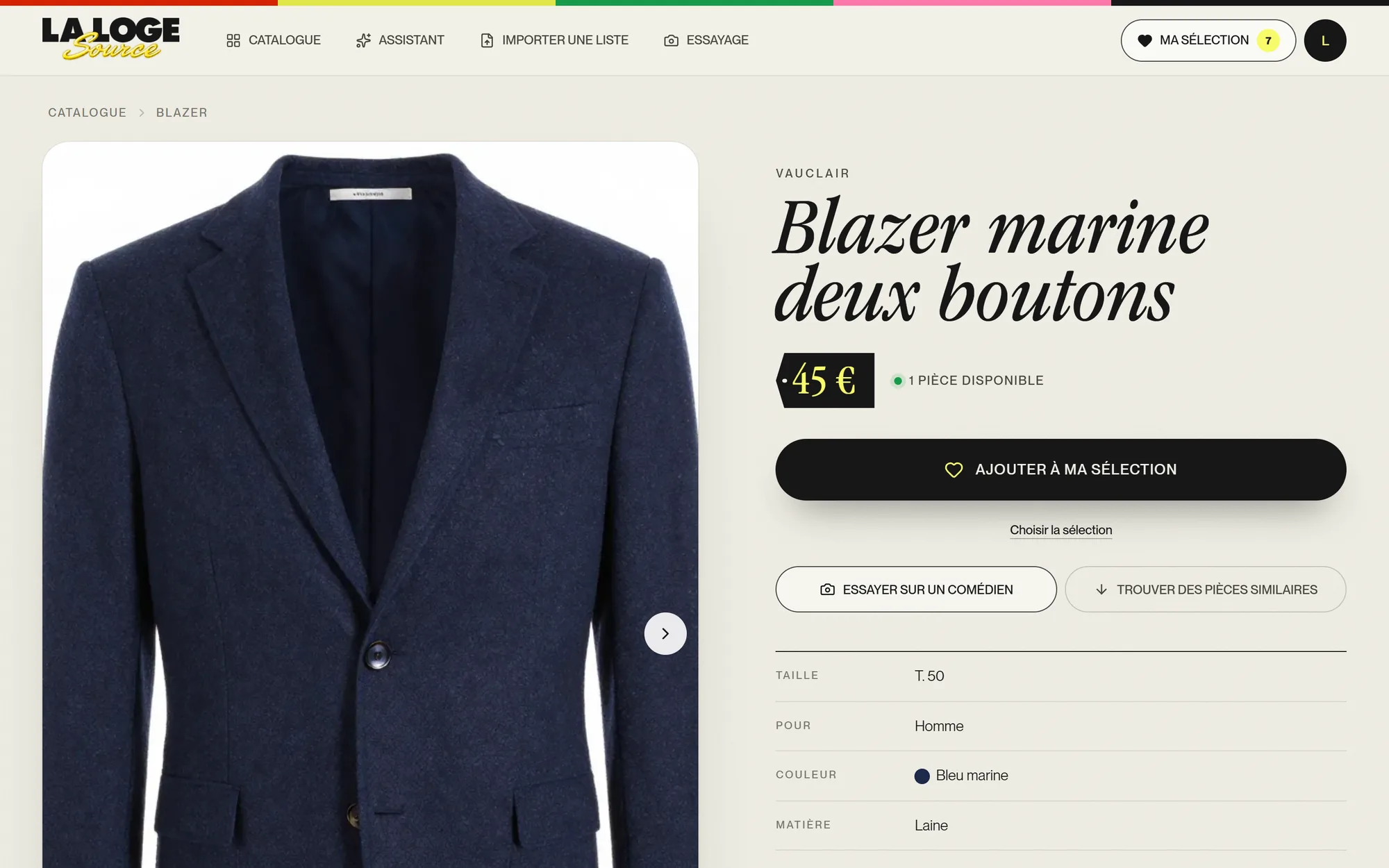
LA LOGE resells costumes from film and TV shoots in Paris. We built the app that catalogues that stock from a phone with a French voice assistant, and LA LOGE Source, where costume teams search it.
LA LOGE Catalogue is an internal PWA for digitising a second-hand costume stock from a phone. You show the garment to the camera and talk to a French voice assistant (OpenAI Realtime), which reads the photos and the label, asks only for what is missing and fills the record through tool calls. On 29 October 2026 the live catalogue held 167 products, with a median capture time of 2 min 1 s. Ready pieces are published on LA LOGE Source, where costume teams search, build selections and request reservations.
- Client
- LA LOGE · Voice cataloguing
- Sector
- Second-hand film costumes
- Where
- Paris
- Year
- 2026
- Deliverables
- Voice and camera capture app (PWA)
- Catalogue and review queue
- Pilotage and AI costs
- LA LOGE Source (B2B)
- Selections, reservations and virtual try-on
- Services
A stock nobody could search
LA LOGE collects costumes from film and TV productions and resells them. Productions kept buying basics new because searching second-hand stock, checking sizes and building silhouettes took too long. The plan had two steps. First, make the stock readable by AI, as structured records with photos, sizes and costume tags. Then let costume teams search it by intent, such as «10 fairly classic male office workers».
Step one had to fit into a shop's working day. The pilot set three targets: 90 seconds or less per garment, at least 95% of required fields filled, and under 10% corrections.
An assistant that only writes through tools
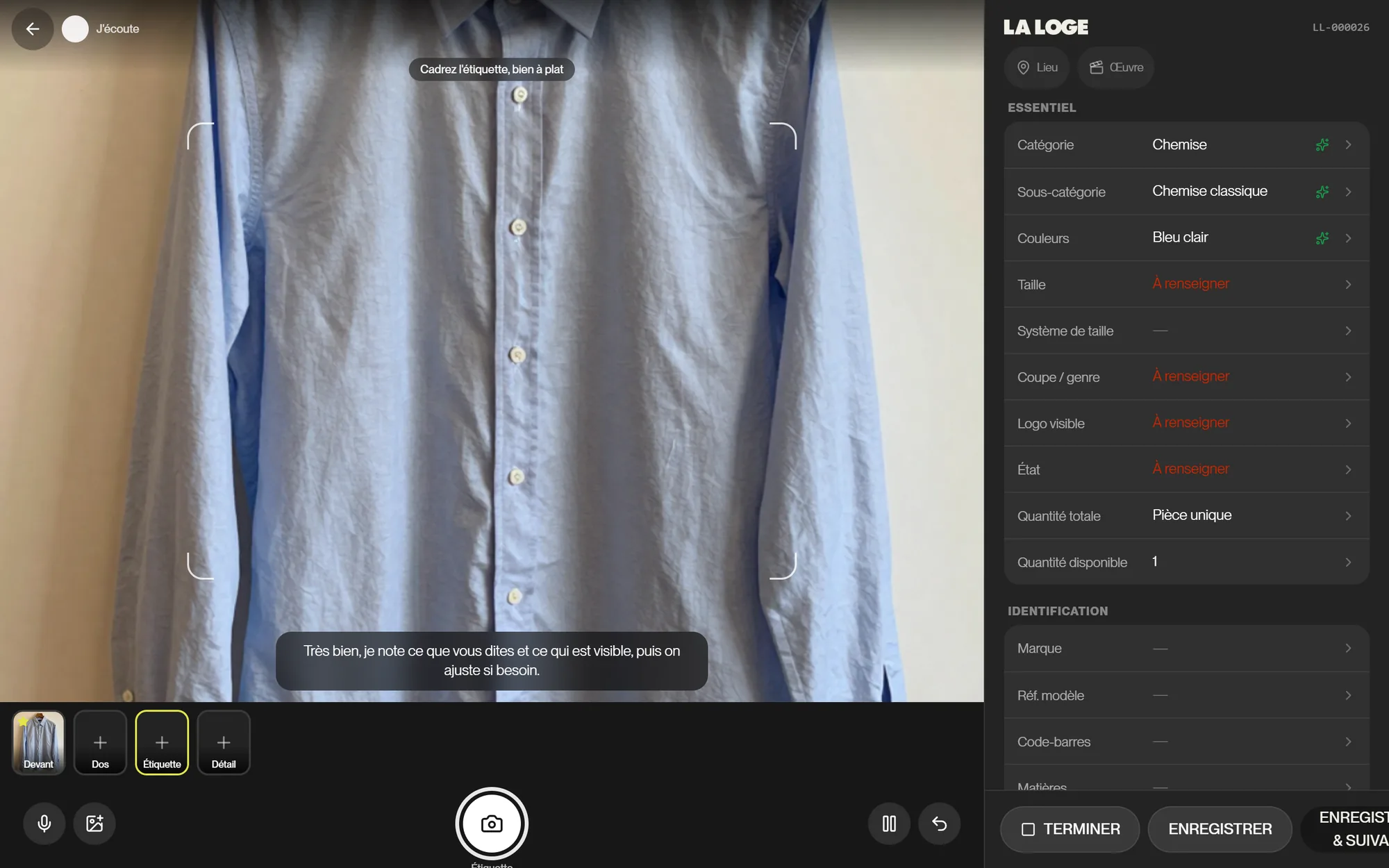
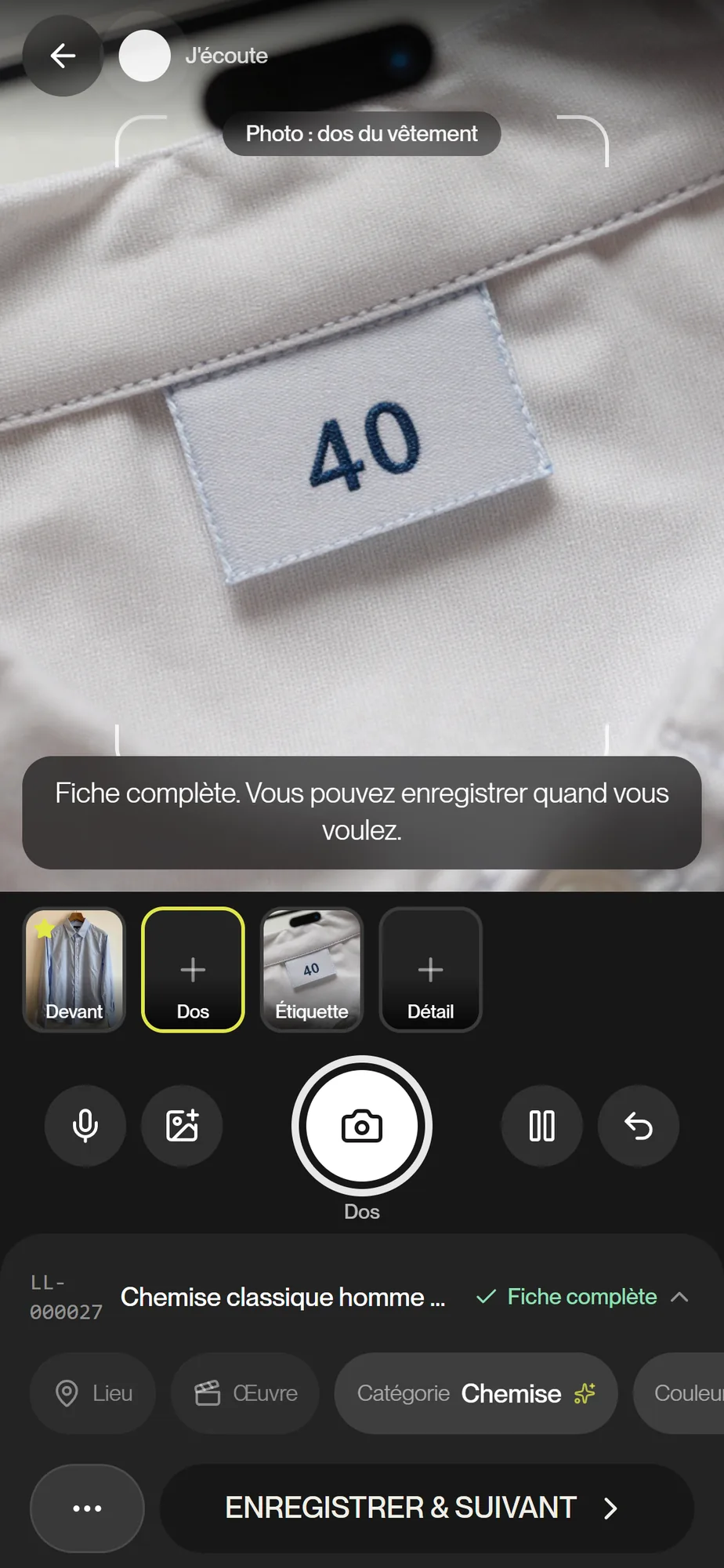
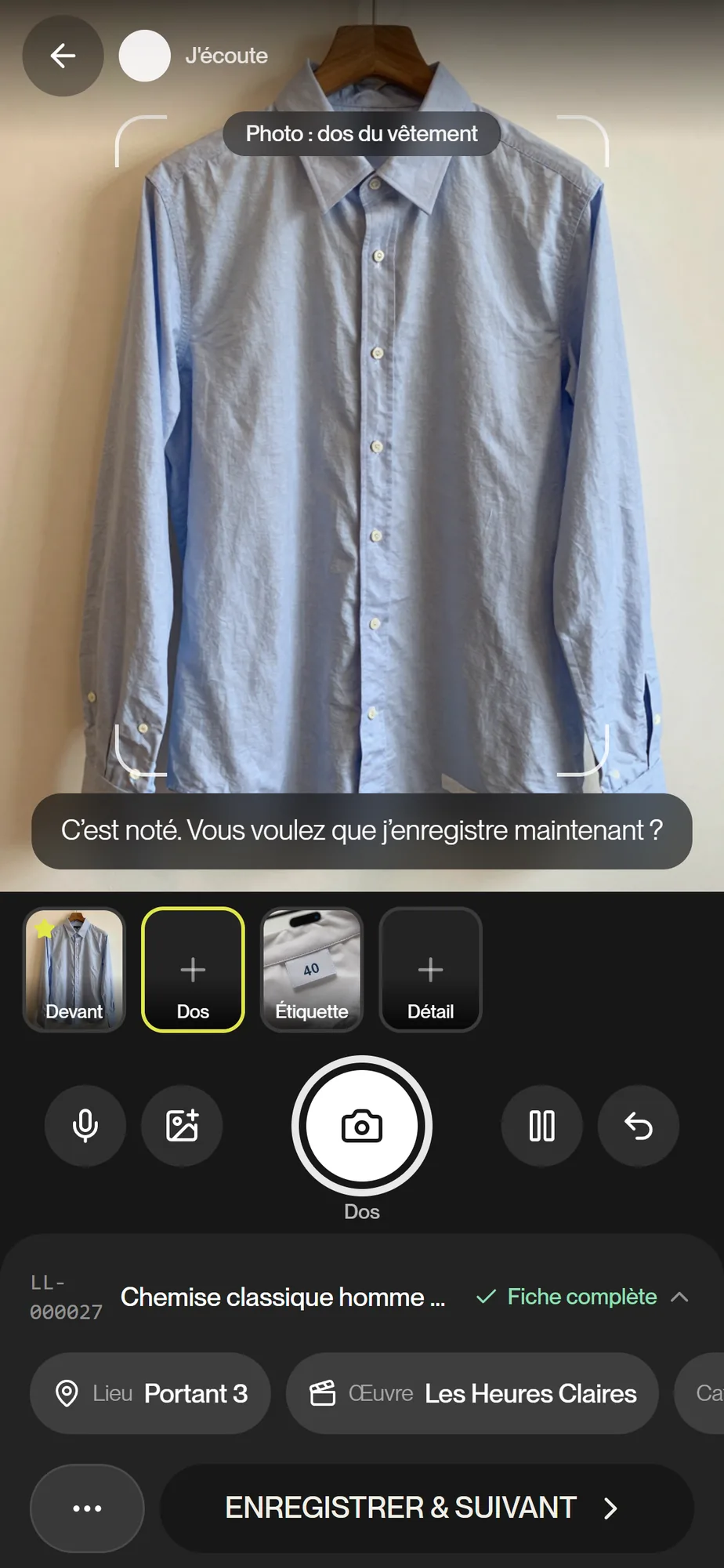
We built the app on Next.js 16 and Supabase (Postgres 17 with RLS on every table, private Storage and pgvector), installable as a PWA. During a capture, the phone opens a WebRTC session with OpenAI Realtime (gpt-realtime-2.1-mini by default, gpt-realtime-2.1 one tap away) and sends it the front, back, label and detail photos. The assistant can change the catalogue only through 16 tools (fill fields, ask for a photo, mark a value as unknown, set the rack or the production, save), and every call goes through a validated endpoint, bound to the product in progress.
We tested both voice models in 36 scripted sessions on real LA LOGE garments. gpt-realtime-2.1 completed 15 records out of 15 and invented nothing; the mini model left 5 of 15 to review, wrote invented notes and misread one brand. Since then the app refuses empty values and notes invented from the photo, whichever model runs. Each model, its price and its per-garment cost can be switched in Réglages › Fonctions & coûts.
-
01
It asks only for what is missing
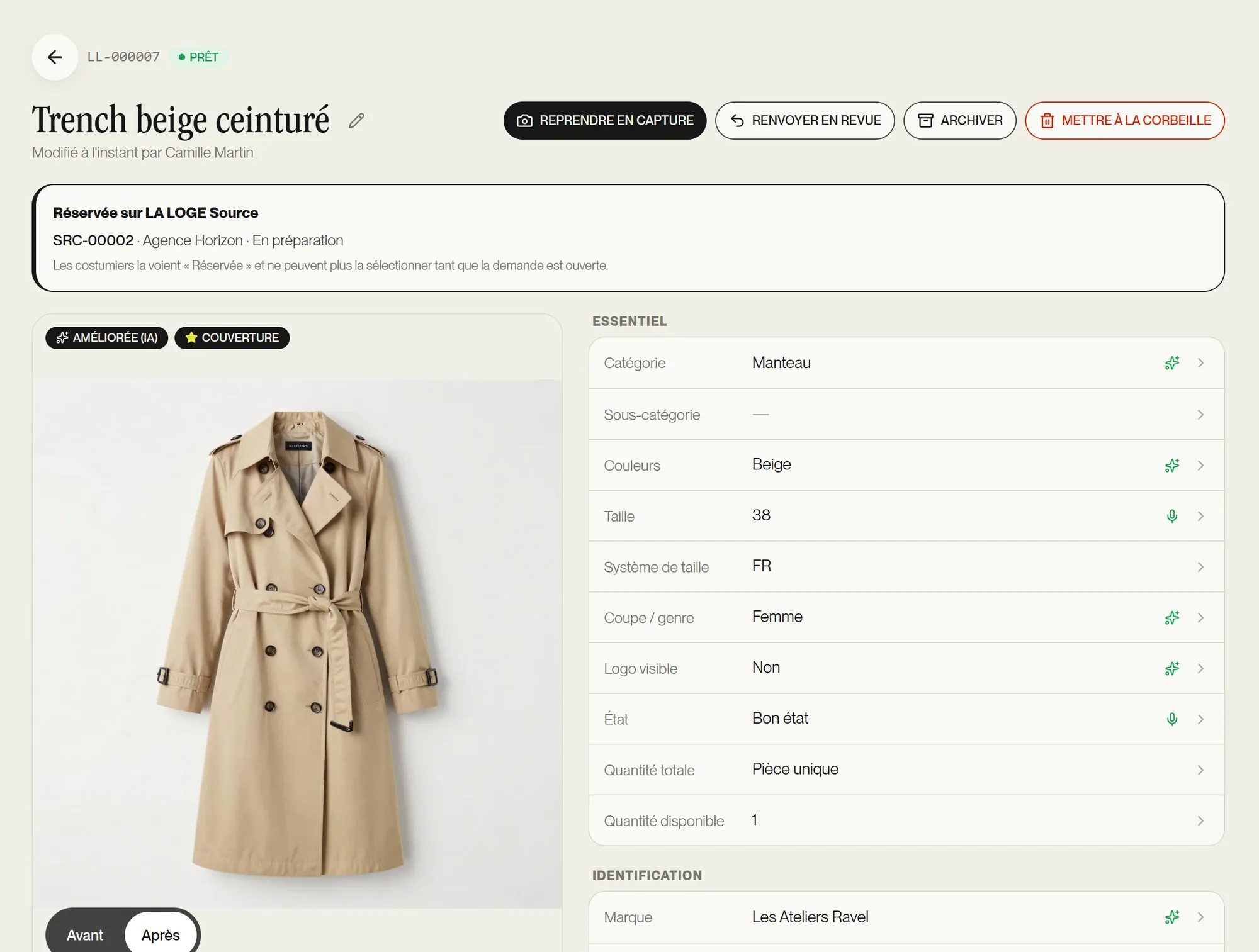
What the photo shows (category, colour) the model fills in; what only the shop knows, such as condition, rack or production, comes by voice. Each field keeps its source, and the product page shows it with an AI or microphone icon.
-
02
Rate limits handled inside the session
On 5 and 6 October, in production, OpenAI returned 120 «Assistant temporairement saturé» errors on the tokens-per-minute limit. The app now asks for the same answer again after 2, 4, 8 or 16 s instead of reconnecting, and offers to switch to «Sans voix».
-
03
Photos-only mode
With no microphone, each new photo is read by the photo-analysis model (gpt-6-luna). It costs about $0.003 per garment, roughly 4 to 5 times less than the mini voice assistant.
-
04
LA LOGE Source
Costumiers search by description, import a list, try a garment on an actor and send reservation requests. A piece in an open request shows as «Réservée» to the others, and costumiers never read internal tables: every read goes through functions that return publishable columns only.
The project in pictures
9 images · Open any image to see it full size.
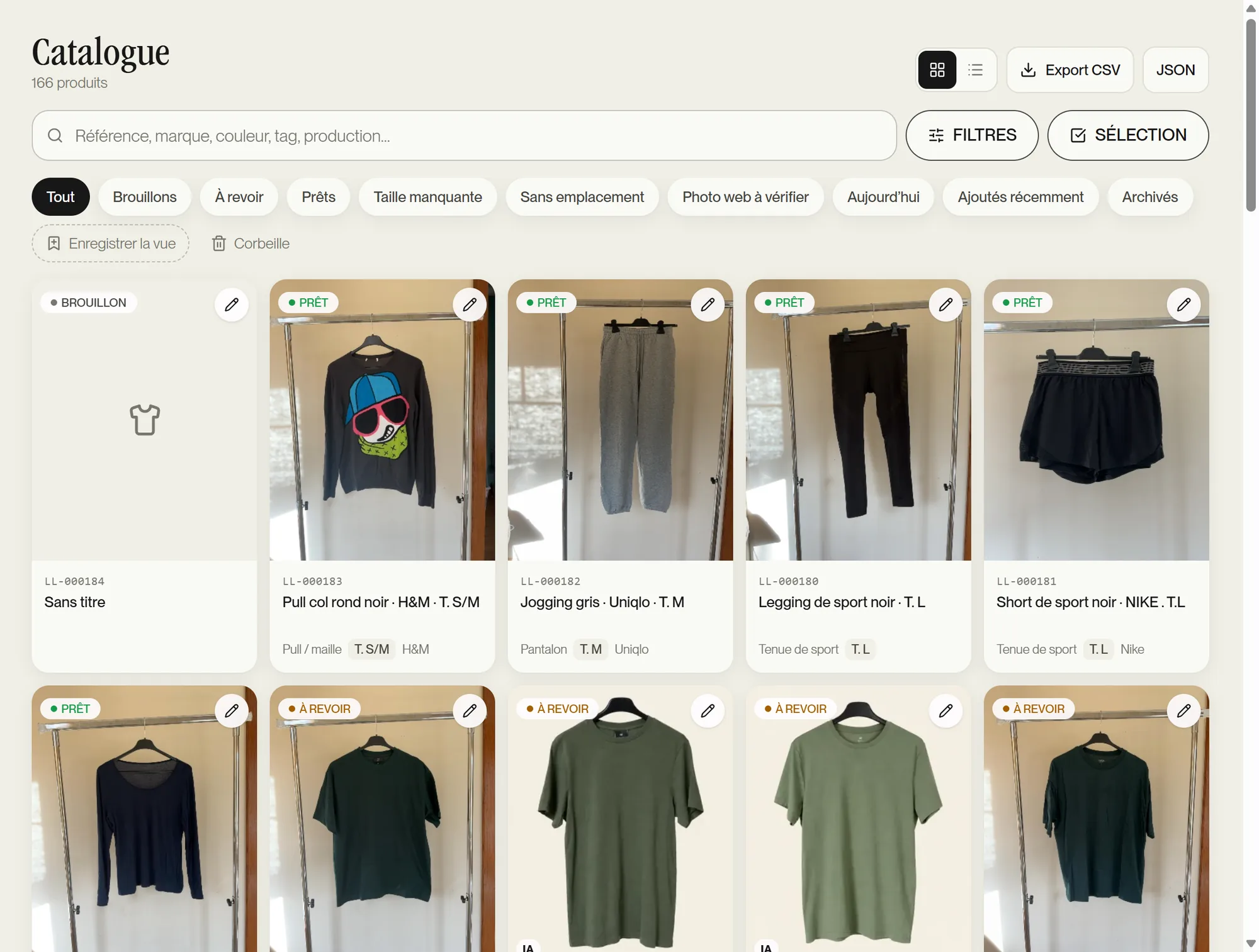
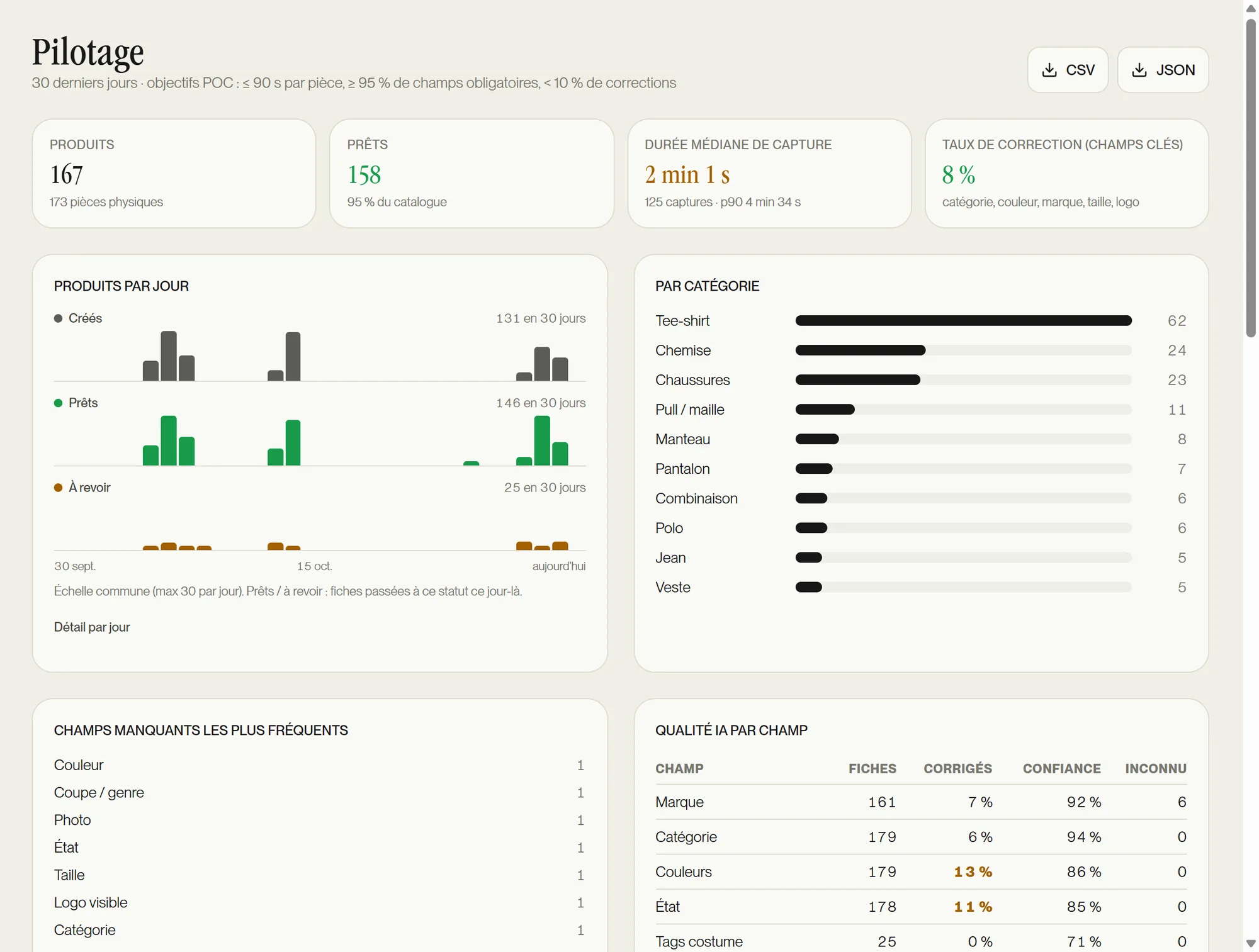
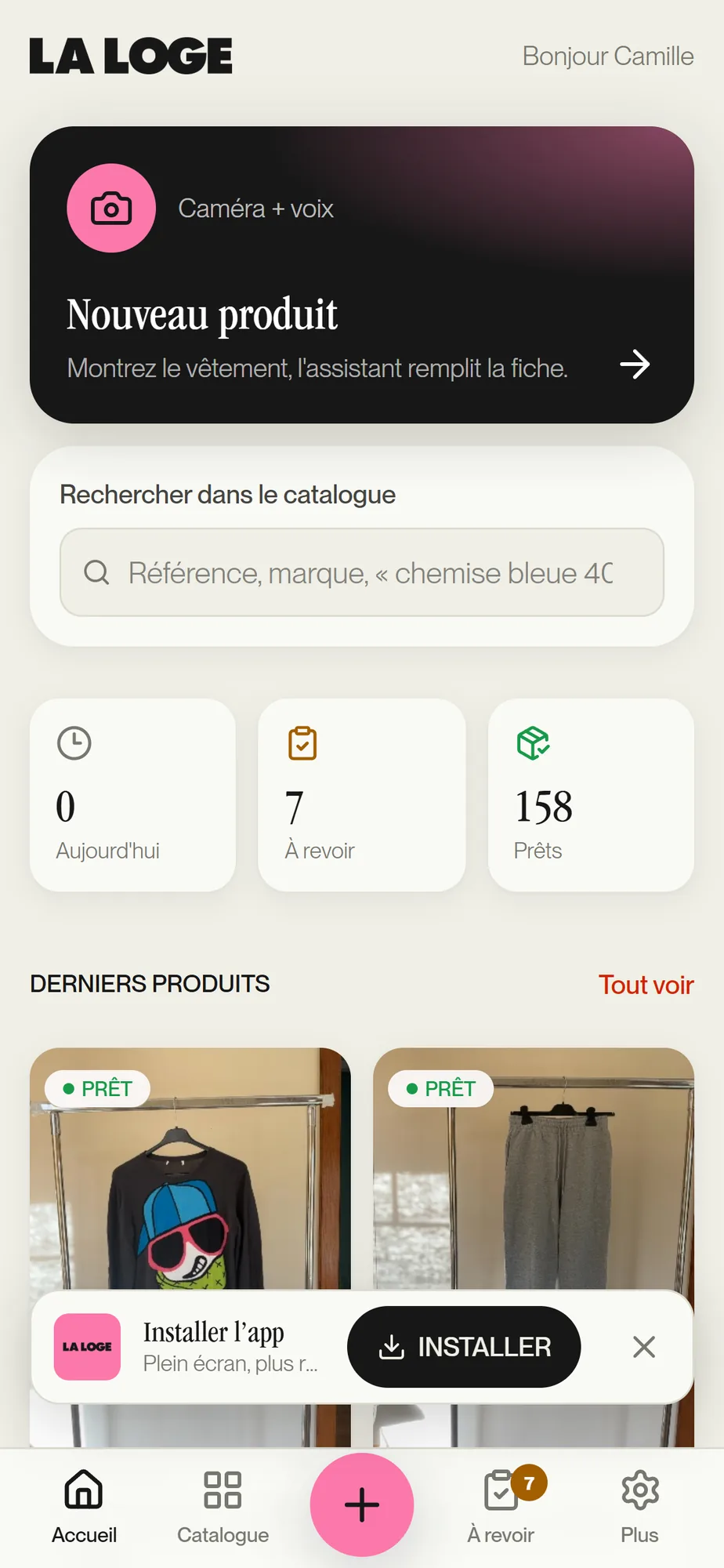
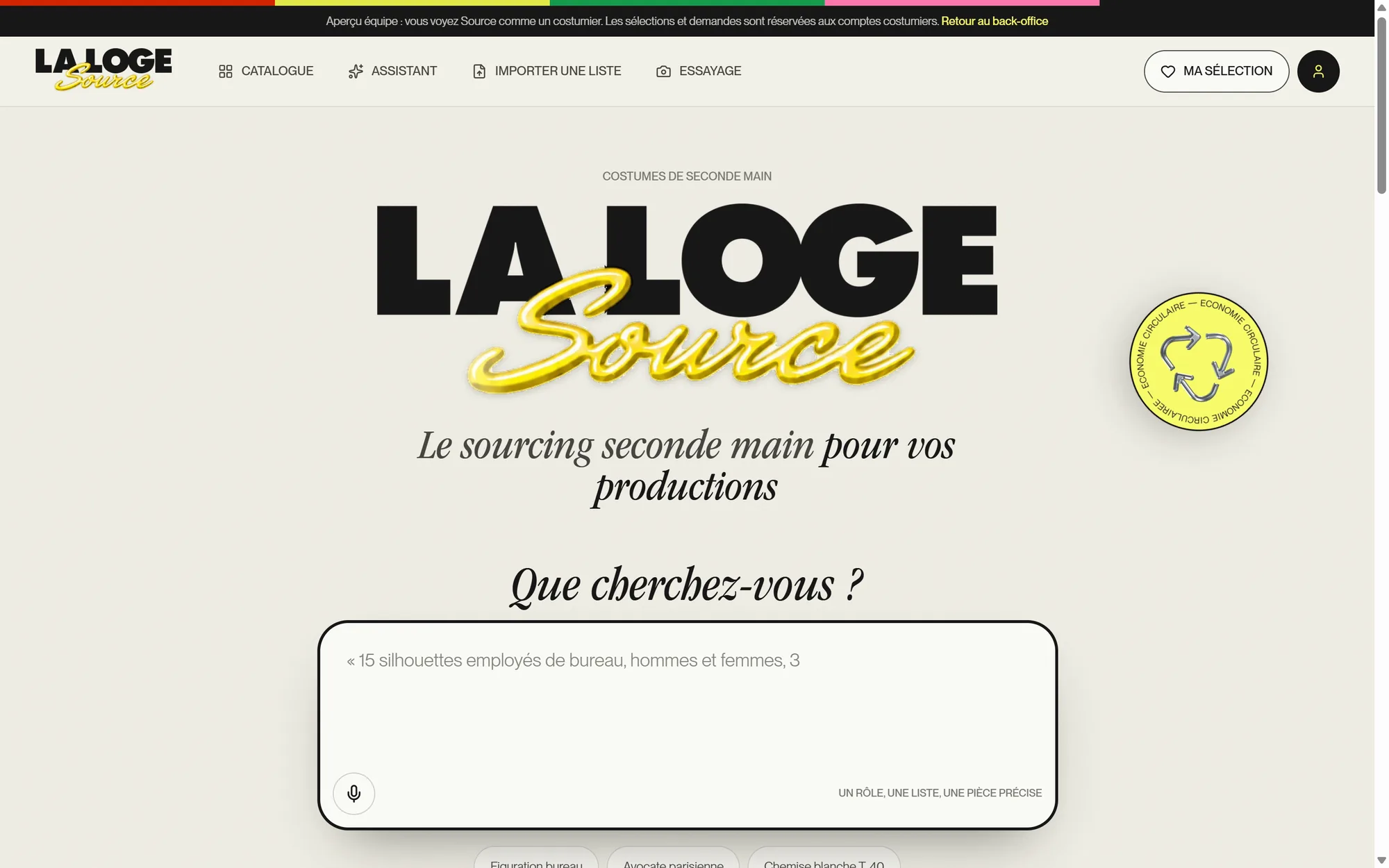
167 products, with the pilot's numbers in view
On 29 October 2026, Pilotage showed 167 products (173 physical pieces), 158 ready and 7 to review, with 117 pieces published on Source. The correction rate on key fields is 8%, inside the under-10% target. The median capture time, 2 min 1 s over 125 captures, is still above the 90-second target. The measured AI cost is $0.042 per garment over 133 garments.
- 167 products catalogued, 117 pieces published on LA LOGE Source
- 8% correction rate on key fields (target: under 10%)
- 2 min 1 s median per capture (target: 90 s)
- $0.042 of AI per garment, measured over 133 garments
The questions we hear often
How does AI inventory cataloguing by voice work at LA LOGE?
You show the garment to the phone and talk. A voice assistant (OpenAI Realtime) reads the photos and the label, asks for what is missing and fills the record through validated tools. The record is then ready for the catalogue and for LA LOGE Source.
How much does it cost to catalogue a garment with AI?
With the default models the estimate is about $0.02 per garment. The cost measured on the live catalogue was $0.042 per garment over 133 garments. Photos-only mode brings it to about $0.003.
What happens when the assistant gets something wrong?
Uncertain values and possible duplicates go to a review queue. Each field shows whether it came from the photo or the voice and can be corrected by hand. On the live catalogue, 8% of key fields get corrected.
Cases close to this one
 Read more
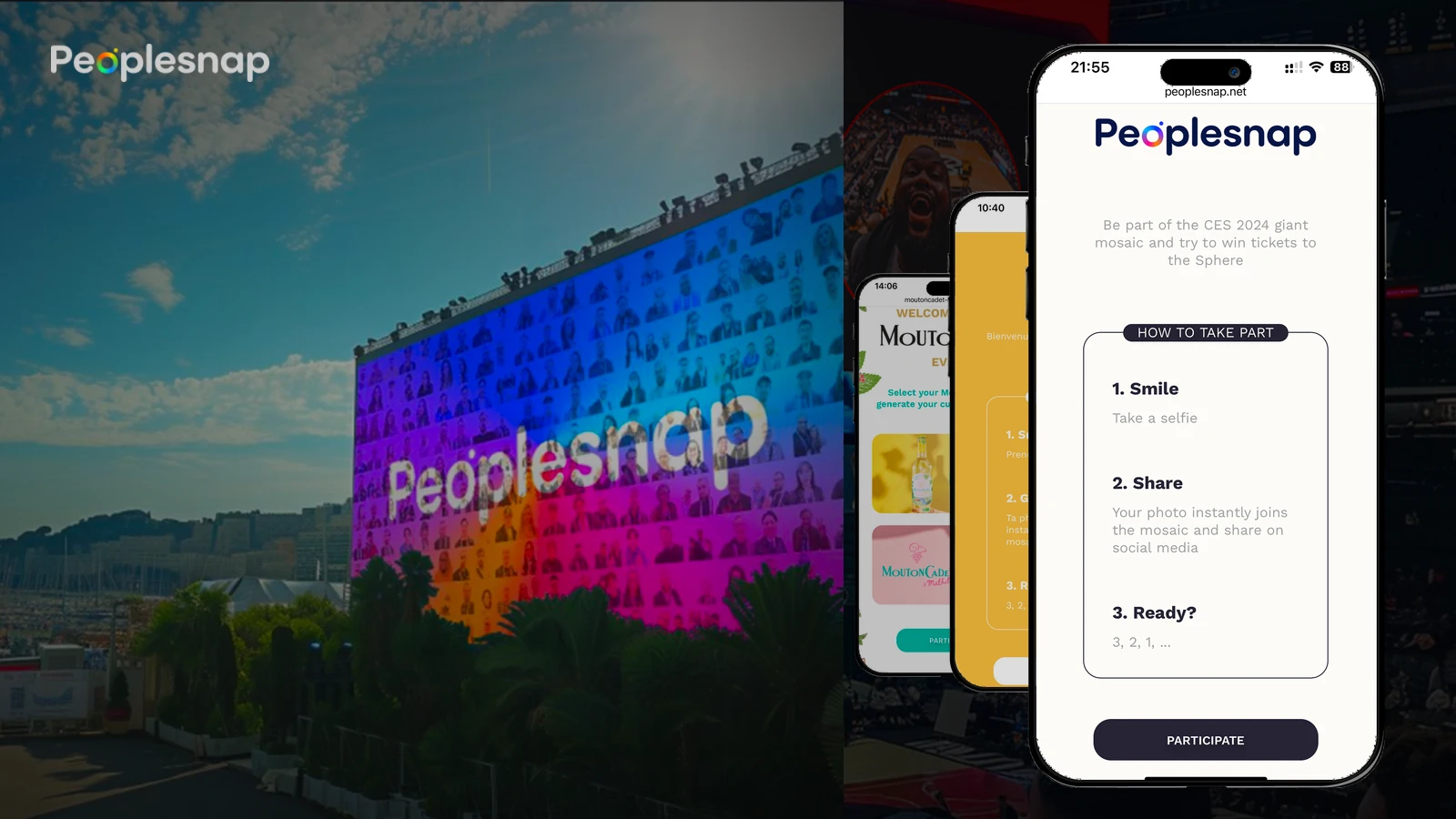
Peoplesnap
From smartphone to DOOH mosaic, without a single booth
Peoplesnap is Slash Experience's photobooth product: a white-label web app that turns each guest's phone into the activation. QR, selfie, AI editing (100+ parameters), social share, print and mosaics on event screens. Already live for Mouton Cadet, La French Tech Bordeaux, CEA Marcoule, Denver Pub Crawl, With Agency, We Love Beer and CES Las Vegas 2024.
Learn more →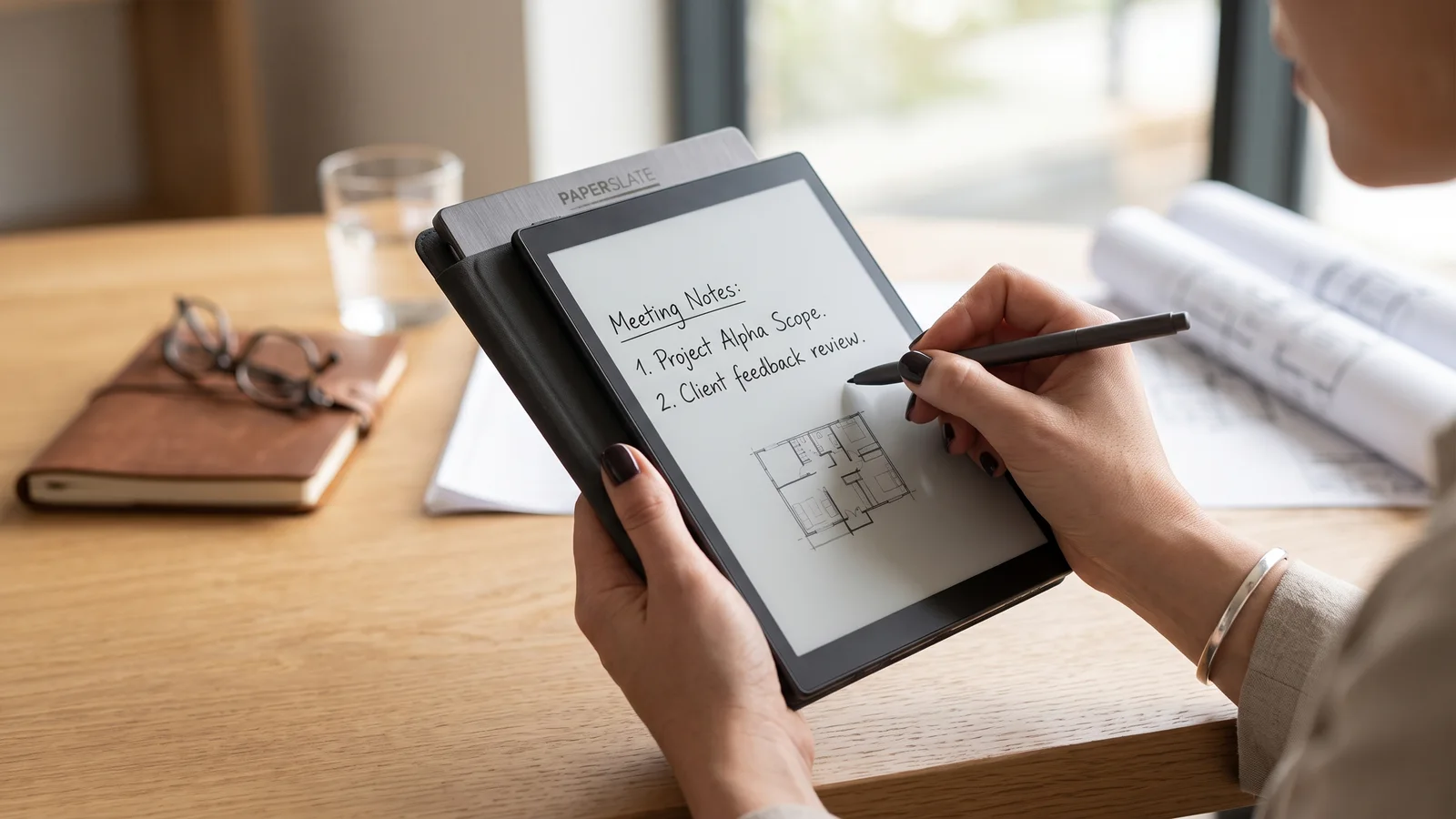 Read more
Paperslate · E-Ink + AI
E-Ink notebook with AI retranscription
Paperslate product: digital paper tablet with real writing feel (Pro and standard models) and a GenAI layer that retranscribes handwriting, formulas and diagrams to Word or PDF.
Learn more →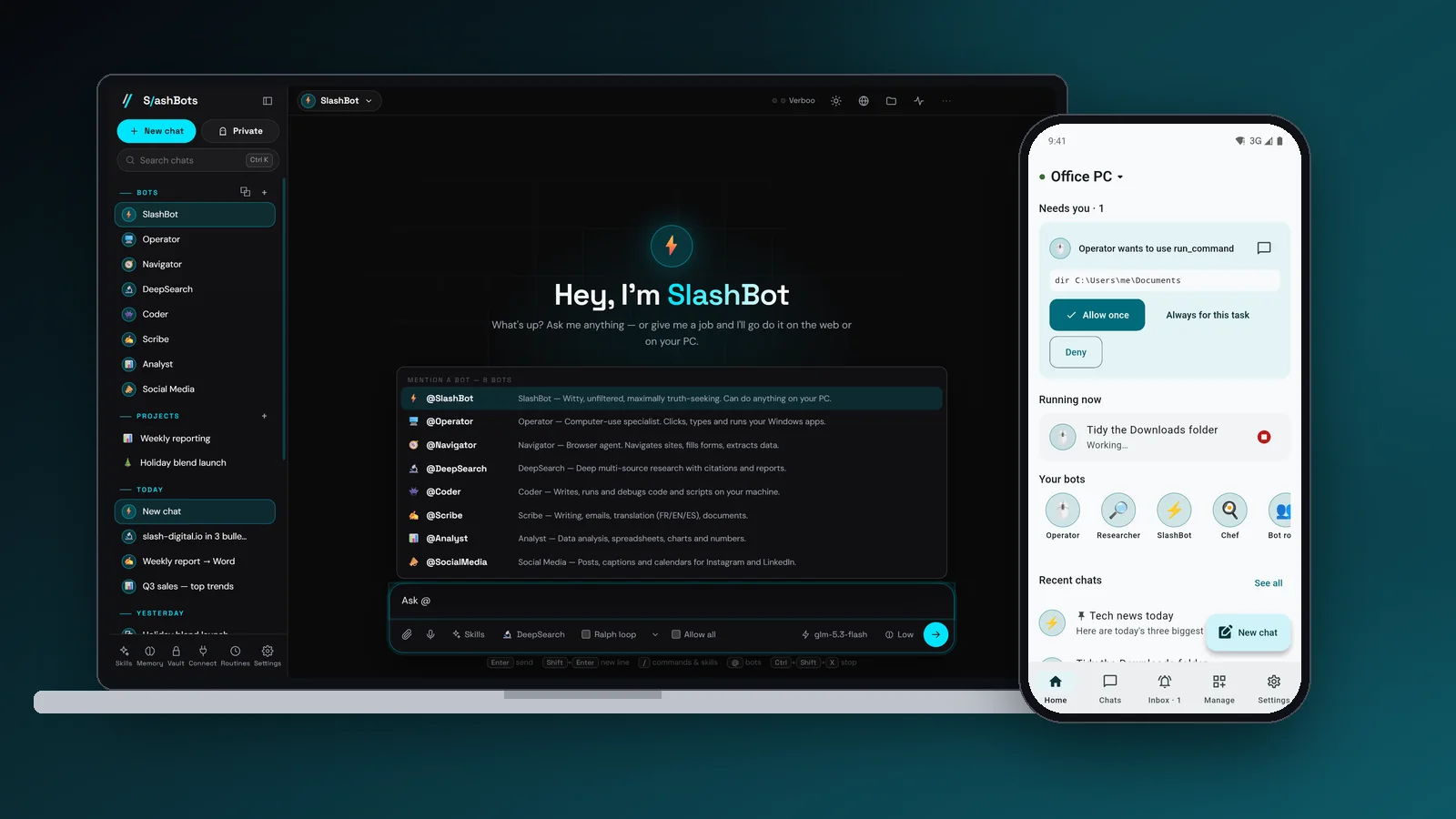 Read more
SlashBots · Desktop agents
Desktop AI agents for our own team
SlashBots, our Windows and Linux app: seven bots with a built-in browser, computer use, 421 skills, memory, MCP connectors, routines and a phone companion.
Learn more →Let's put it in production
Tell us your challenge. We reply within 24 business hours with an honest first read: if we can help, we'll say how; if not, we'll say who can.
I reply personally. No endless forms, no canned replies.